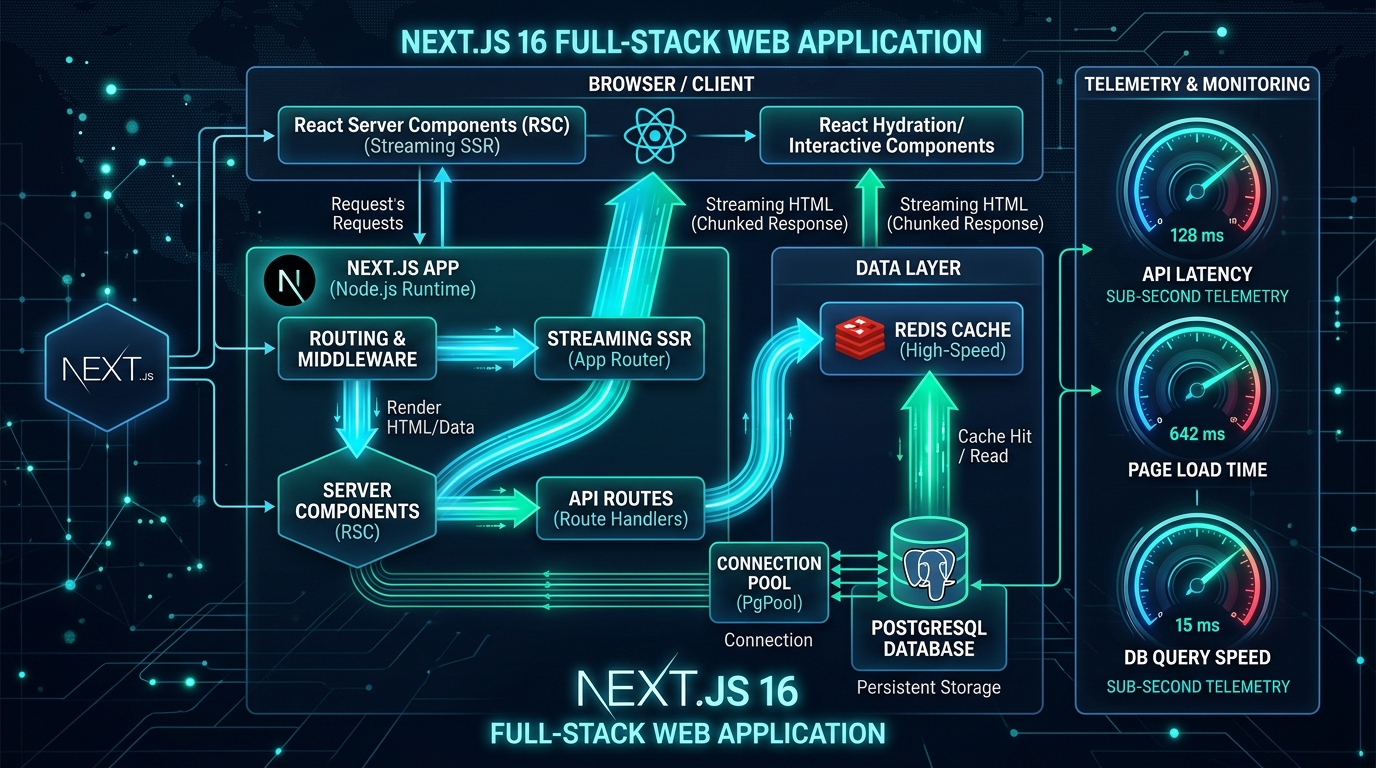
Next.js 16 and React 19 provide unprecedented capabilities for engineering ultra-fast web applications. However, taking full advantage of React Server Components (RSC) requires a fundamental shift in how developers structure state, data fetching, and bundle boundaries.
The golden rule of Next.js App Router performance is: Keep components on the server by default. Push "use client" as far down the component tree as possible.
// Good Practice: Server Component fetches data, Client Component handles interactivity
import { Suspense } from "react";
import { MetricChartSkeleton } from "@/components/skeletons";
import { RealtimeChartClient } from "@/components/client/realtime-chart";
import { getAnalyticsData } from "@/lib/db/analytics";

export default async function AnalyticsPage() {
  const initialData = await getAnalyticsData();

  return (
    <main className="p-8 space-y-6">
      <h1 className="text-2xl font-bold">Analytics Dashboard</h1>
      <Suspense fallback={<MetricChartSkeleton />}>
        <RealtimeChartClient initialData={initialData} />
      </Suspense>
    </main>
  );
}
When deploying Next.js API routes or Server Actions to serverless environments (like Vercel or AWS Lambda), each function invocation can spawn a new database connection, rapidly exhausting PostgreSQL connection limits.
Always instantiate Prisma or your ORM client as a global singleton and route traffic through a connection pooler like PgBouncer or Supabase Pooler.
- Zero unnecessary client-side JavaScript in static layout sections.
- Dynamic image optimization with defined aspect ratios to eliminate Cumulative Layout Shift (CLS).
- Streaming Suspense boundaries around slow third-party API fetches.
- Comprehensive OpenGraph and JSON-LD structured data for search engine visibility.